

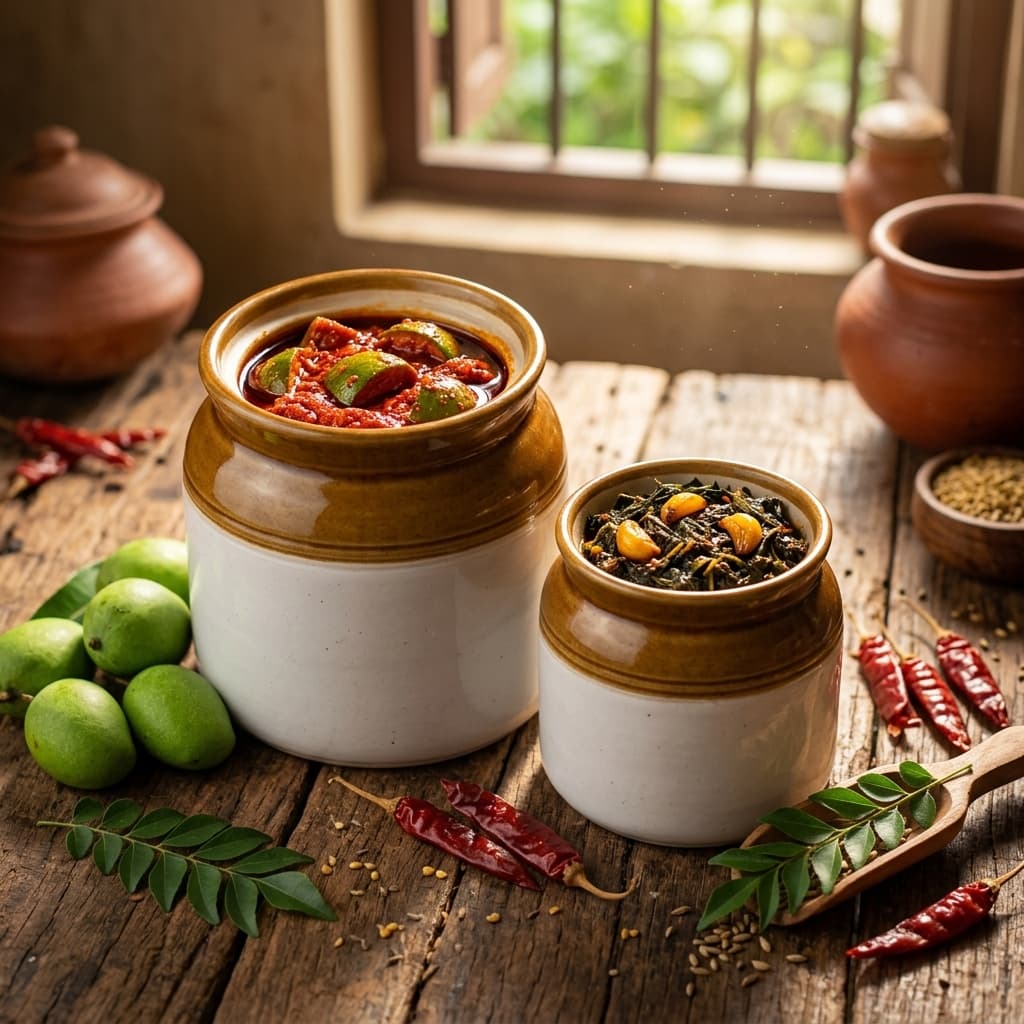
How Homemade Andhra Pickles Are Made: From the Kitchen Batch to the Jar at Your Door
People who grew up with a pickle jar on the kitchen shelf rarely ask how it was made. They remember mustard and chilli in a wide vessel, a dry spoon nobody was allowed to rinse and put back wet, and an elder who would not let anyone dip in before the jar had settled.
If you are buying Andhra pickles online for the first time, that memory is harder to trust from a screen. This guide explains how homemade Andhra pickles are made in home kitchens, what "small batch" and "no chemical preservatives" mean when you order from Pickle Basket, and what you should check when the parcel arrives. It is not a secret recipe and it does not invent timings or spice weights we do not publish.
Why the method matters when you order a jar
A pickle is not a sauce cooked and eaten the same afternoon. It is fruit, a leaf or a piece of meat that has been seasoned, held under oil and given time so the flavours settle. Done carefully, the jar tastes like the kitchen it came from. Rushed or flooded with water, it spoils.
That is why people search for homemade Andhra pickles rather than any bottle with Andhra on the label. They want familiar mustard heat, fenugreek bitterness and chilli, held in enough oil to travel. Understanding the method helps you judge a jar when you open it and store it so the last spoon is as good as the first.
The traditional Andhra path, explained simply
Across Andhra and Telangana home kitchens, the broad path is similar even when every household guards its own proportions.
Choose and prepare the main ingredient. Raw mango for avakaya, tender or aged fruit for other mango styles such as magaya or koru pachadi, sorrel leaves for gongura, tomatoes, amla (usiri), lemon, ginger, drumstick, or pieces of chicken, mutton or prawn for the non-veg jars. The ingredient has to be sound. A pickle will not rescue fruit that has already turned.
Keep water out. This is the rule elders repeat most often. Knives, boards, bowls and spoons need to be dry. Moisture is what lets unwanted growth start later, which is why our storage advice always begins with a dry spoon.
Season with the Andhra spice backbone. Most Godavari-style jars lean on red chilli, salt, mustard (aavalu) and fenugreek (menthulu), often with garlic where the recipe calls for it. Mustard gives that sharp, nose-tingling edge. Fenugreek adds a slight bitterness that stops the pickle tasting flat. We wrote a fuller note on why mustard and fenugreek matter.
Seal the work under oil. Oil is not only richness. In an Andhra pickle it is a cover. As long as the pieces sit under a clean layer of oil and the lid is closed, air and stray moisture have a harder time spoiling the batch. That is also why people ask why our jars look "oily"; there is a separate piece on why Andhra pickles use so much oil and how to use what is left.
Give the jar time to settle. Freshly mixed pickle can taste raw or harsh. Home cooks wait until the chilli, salt and sourness feel rounded. How long that takes depends on the ingredient and the weather; we do not publish a single number that pretends every jar behaves the same. Many families also sun-cure certain mango pieces on a terrace, which is a home tradition rather than a factory step we claim for every product.
What homemade and small-batch mean at Pickle Basket
Pickle Basket is a homemade Andhra pickle kitchen near Tadepalligudem in West Godavari, not a supermarket brand that manufactures months of stock in advance. As our shipping policy states, every jar is prepared fresh in small batches after we receive your order, with cold-pressed oils and no chemical preservatives. Jars go into food-grade airtight bottles with induction-sealed lids, then into cushioned cartons made for oil and liquid to travel.
That is the practical meaning of homemade here. Small batches let us cook after you order instead of holding a warehouse of jars. Salt, chilli, spice and oil do the preserving work that some commercial brands hand over to additives. You should still treat the opened jar with care; tradition is not a shield against a wet spoon.
If you want the broader kitchen story of this region, read Godavari-style pickles. For a first-order map, see best Andhra pickles to buy online.
How veg and non-veg jars differ
Vegetarian pickles such as avakaya, gongura, tomato and lemon start with produce that is cleaned, prepared and seasoned, then held under oil. They are the jars many families keep on the everyday shelf.
Non-veg pickles such as chicken, mutton and prawn start with meat or seafood that is cooked with the spice path before it goes into the jar. They are richer, and many households keep them for rice on busy nights rather than for every meal. If you are choosing between them, our comparisons of chicken versus boneless chicken and mutton versus chicken are honest starting points.
We do not invent different "shelf lives in days" here. Each product page is the place to check the details for that jar, including how to store it after opening.
How a jar is packed so it can travel
An Andhra pickle is an oil-rich food and cannot travel in a thin pouch. Our packing follows the shipping policy: food-grade airtight bottles, induction-sealed lids, and cushioned cartons designed for oil and liquid.
Once the courier collects the parcel, you receive a tracking link by WhatsApp, SMS and email. We hand over orders within 1 to 2 business days of confirmation. Standard delivery across India typically takes another 3 to 6 business days, depending on the pincode, and we deliver only within India.
When the box arrives, slow down for the first five minutes. Our guide on what to do when your pickle jar arrives covers checking the seal, letting a travelled jar settle, and using a dry spoon from the first serving.
What you should notice when you open a well-made jar
A homemade Andhra pickle should smell of its main ingredient and of chilli, mustard and oil, not of staleness. Pieces should be coated, not sitting in a watery layer, and the oil on top should look like a clear cover.
Taste a small amount with plain hot rice before you decide the heat is too much. Andhra pickle is meant to be eaten in spoons, not scoops. If you are introducing children or someone new to this chilli, start with tomato or magaya. Our notes on pickles for kids, how much pickle is sensible in a day, how to store homemade pickles and signs of spoilage cover what comes after the first taste.
Frequently Asked Questions
Do homemade Andhra pickles contain chemical preservatives?
Pickle Basket jars are made without chemical preservatives. Salt, chilli, spices and a proper oil cover do the keeping, the way home kitchens have done for a long time. You still need a dry spoon and a closed lid after opening.
Are your pickles made in advance and stored for months?
No. We prepare each order fresh in small batches after you place it, then pack and hand it to the courier within 1 to 2 business days. That is the opposite of a factory jar that may have been sitting in a warehouse since last season.
Why is there so much oil in the jar?
The oil is a seal as well as a flavour. It keeps the pieces covered so they stay in good condition during storage and travel. You can spoon a little of that oil over hot rice or into a tadka; nothing needs to be wasted.
How are the jars sealed for delivery?
Bottles are food-grade and airtight, with induction-sealed lids, and they travel in cushioned cartons meant for oil-rich foods. Please check the seal when the parcel arrives and write to us if something does not look right.
Can I order with Cash on Delivery?
Yes, COD is available on serviceable pincodes across India. A Rs 99 advance is paid online to confirm the order, a Rs 50 COD fee is added by the delivery partner, and you pay the balance at the door in cash or UPI. Paying the full amount online skips the COD fee. Details are on our shipping policy.
Taste a jar made the home way
If this is the process you have been looking for, start with a jar your household already understands: avakaya for mango lovers, gongura for the sour leaf, or boneless chicken pickle for an easy rice dinner. Browse all products, or split your first order between veg and non-veg.
We cook after you order. The rest, from the dry spoon onwards, is in your kitchen.
With warmth,
Vidya
Founder, Pickle Basket
About the Author
Vidya
Founder, Pickle Basket