

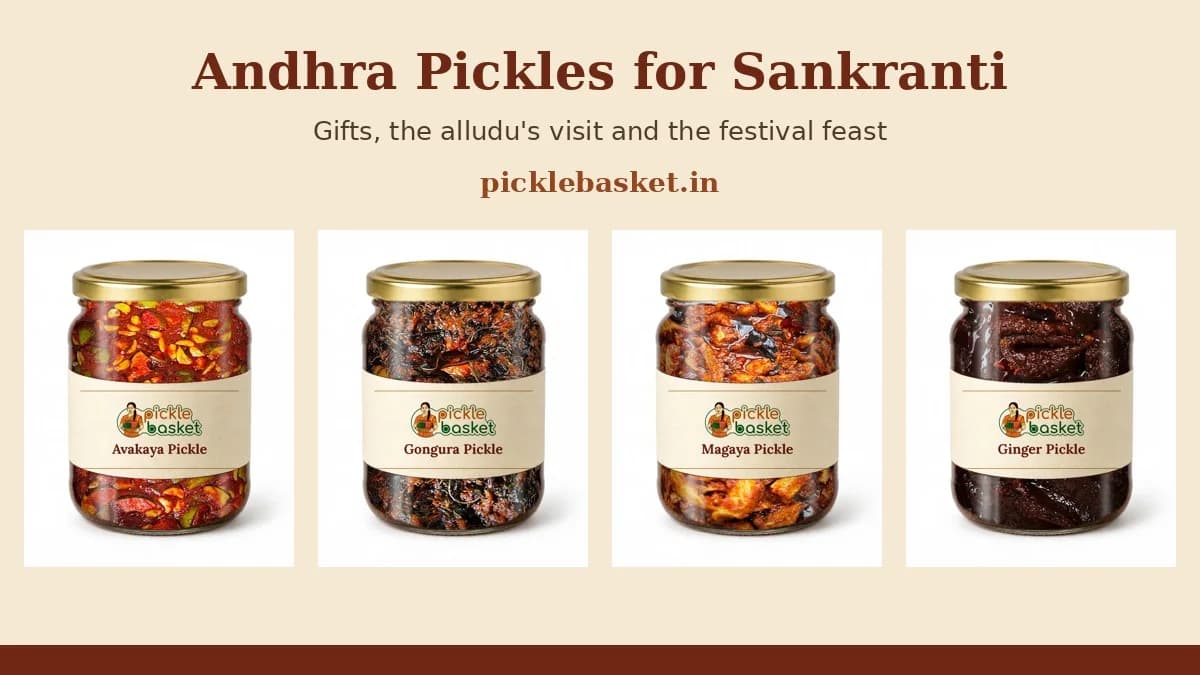
Sankranti Pickles: What to Gift, What to Serve and the Jars Telugu Homes Keep Ready for the Alludu's Visit
In the Godavari districts, where I grew up, Sankranti was never just a day. It was a whole week of preparation. The house was whitewashed, the muggulu grew bigger every morning, the aunts arrived with steel boxes full of ariselu and sakinalu, and one question was whispered in every kitchen: "Alludu garu ekkadi nunchi vastaru, ennintiki?" When is the son-in-law coming, and how many people will he bring?
If you have never seen a proper Sankranti welcome for the alludu, it is something. The son-in-law, often with his whole family, is invited to the bride's home for the festival, and the house tries to outdo itself. Sweets, a feast, new clothes, and somewhere in all that, a few jars of pickle packed to go back with him. This post is about that last part, and about how pickle quietly fits into the whole festival.
A Quick Word on the Three Days
Makar Sankranti falls in mid-January, and in Andhra it is celebrated over three days. The first day is Bhogi, with the morning bonfire. The second is Sankranti itself, the main feast day. The third is Kanuma, which many families spend visiting relatives. Many homes also draw rangoli, which we call muggulu, at the door each morning.
Every one of these days has meals, and every meal needs a little something sharp and salty on the side to balance all that sweetness and ghee. That is where pickles come in.
Why Sankranti Needs Pickle at All
Think about what a Sankranti table looks like. There is pongali and ariselu, bobbatlu and sakinalu, maybe garelu and pulihora. Sweets and fried foods in plenty. By the second or third helping, the tongue starts asking for something tart, spicy and plain. A spoon of pickle next to hot rice, pappu and ghee resets the whole plate.
Our elders never planned a festival lunch without at least three kinds of pickle on the table: one mango, one leafy or tangy, and one more for variety. I have kept that habit, and I would suggest it to you too.
The Festival Feast: Which Jars to Open
Avakaya for the main meal
On the big day, it has to be avakaya. Our Avakaya Pickle is raw mango with mustard, red chilli, fenugreek and garlic in groundnut oil. With steaming rice, kandi pappu and a spoon of ghee, it is the meal people travel home for. If you are unsure whether your guests prefer the fresh or the sun-dried style, our post on avakaya vs magaya explains the difference.
Gongura for the tangy lovers
Every family has one person who says, "Gongura lekunda bhojanam enti?" Our Gongura Pickle is made from red sorrel leaves and is fully vegetarian. It is sharp and sour, and it stands up well to all the sweet dishes on the table. If a guest has never tried it, our simple introduction to gongura will help them enjoy it the first time.
Ginger for the rich, fried dishes
Between garelu, punugulu and the other fried items, a small bite of ginger pickle feels like a pause. Our Ginger Pickle is sweet, sour and spicy in one spoon, and it goes well with tiffin items on the morning after a feast too. We have a full piece on allam pachadi and pesarattu if you want ideas.
Something non-veg for Kanuma
Kanuma is the day many Andhra families cook non-veg, and visiting relatives often expect it. If you do not have time for a full spread, a jar of Chicken Pickle or Mutton Pickle with hot rice makes a quick second meal that guests remember. Not sure which to pick? Our mutton vs chicken pickle comparison helps.
Pickles for the Alludu's Gift Basket
Now to the part I like best. When the son-in-law and his family leave, the bride's mother packs a bag, and pickle is nearly always in it. It is a gift that says "this is from our kitchen, so remember us when you eat at home."
A simple basket idea, with three jars:
- One mango jar, Avakaya or Magaya, for daily meals.
- One tangy jar, Gongura or Tomato, for variety.
- One non-veg jar, Gongura Chicken, if the family eats non-veg.
If you are choosing for someone who lives in another state or abroad, please read our guide on sending pickles to children in another city. It covers packing and what to tell the recipient when the parcel arrives.
Our earlier piece on festive gifting for Dussehra and Diwali has more gift ideas that work for Sankranti as well, especially if you are gifting to many relatives at once.
For Those Who Cannot Go Home This Sankranti
Many of our customers live in Bengaluru, Hyderabad, Chennai and further away, and cannot take leave for the festival. If that is you, a jar of homely pickle on the Sankranti plate can bring a little of the festival to a small flat. If you are far from home, a little pongal, a couple of sweets and a jar of avakaya make a good festival meal for one. Our guides to Andhra pickles online in Bangalore and in Hyderabad tell you more about how we deliver there.
When to Order for Sankranti
Because we make every jar fresh after you order, please do not leave the order for the last few days. Our shipping policy says orders are handed to the courier within 1 to 2 business days, and standard delivery usually takes 3 to 6 business days after dispatch, depending on the pincode. Festival season can add courier delays. If you want the jars to be with you before Bhogi, order at least a couple of weeks ahead and, if you are gifting, ask the recipient to expect a parcel. The latest terms are always on our shipping policy page.
For gifts, you can enter the recipient's address as the delivery address when you order, and if you are unsure how, message us on WhatsApp.
A Few Small Pickle Habits for a Busy Festival House
- Use a clean, dry spoon every time. With many hands in the kitchen at Sankranti, this is the one rule that is easy to forget.
- Keep the pieces under the oil and close the lid tightly. Our guide to storing homemade pickles has more detail.
- Put pickle in a small bowl for the table, instead of bringing the whole jar to the dining mat.
- Read the shelf-life information on the jar label for your batch.
How to Order on picklebasket.in or WhatsApp
You can browse our vegetarian and non-veg pickles on picklebasket.in, or message us on WhatsApp at +91 9848658989. Tell us how many people you are feeding or gifting, and we will help you choose.
Our veg pickles are ₹219 for 250 g, ₹429 for 500 g and ₹799 for 1 kg at the time of writing. Non-veg prices vary by jar, so please check each product page before ordering.
Cash on Delivery is available on serviceable pincodes. You pay a ₹99 advance online to confirm the order, and a ₹50 COD fee is added by the delivery partner. If you pay fully online by UPI or card, there is no COD fee. Our COD guide explains it step by step.
May your Sankranti have bright muggulu, a full table and a few good jars on it.
From our kitchen near Tadepalligudem to yours,
Vidya
Founder, Pickle Basket
About the Author
Vidya
Founder, Pickle Basket