

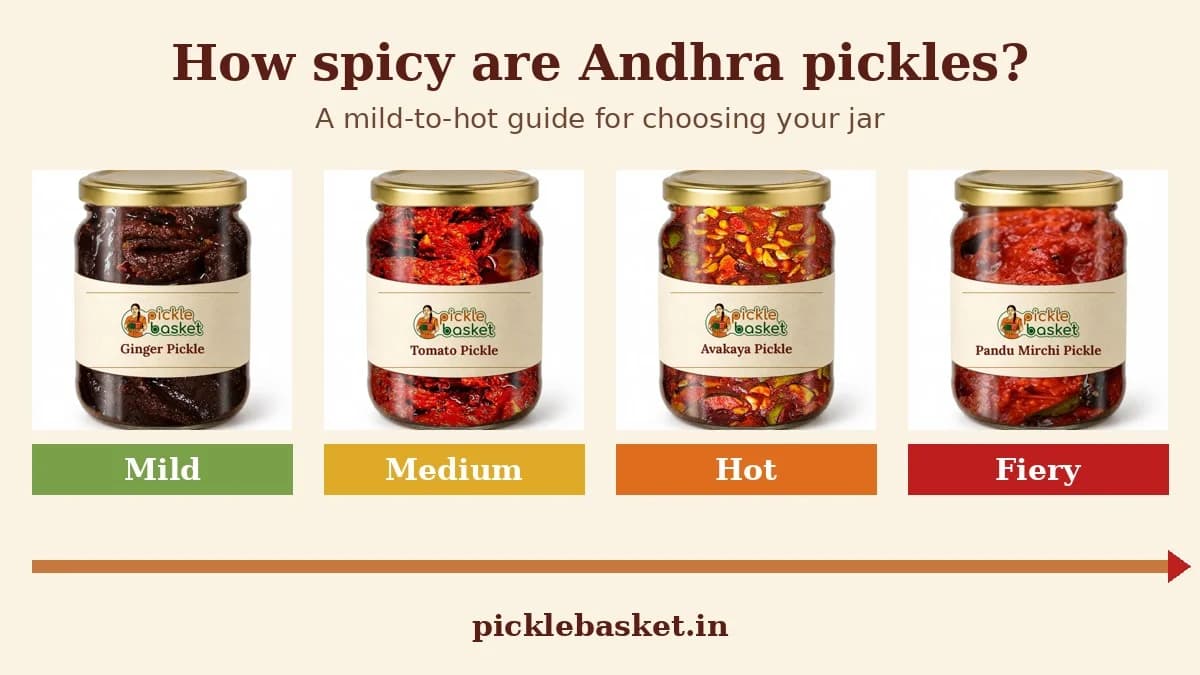
How Spicy Are Andhra Pickles? A Mild-to-Hot Guide for Choosing Your Jar
"Is it very kaaram?" That is the question I hear most on WhatsApp, often before anyone even asks the price. Sometimes it comes from a Telugu family ordering for a new daughter-in-law from another state. Sometimes it is a young couple in Delhi or Kolkata who tasted avakaya once at a friend's house, loved it, and also remember needing three glasses of water.
It is a fair worry. Andhra food has a name for heat, and our pickles are made the way village kitchens around Tadepalligudem have always made them, with plenty of red chilli. But here is something people outside Andhra are often surprised to hear: not every pachadi is a fire-cracker. Some jars are gentle and almost sweet. Some sit comfortably in the middle. And a few are honestly meant for people who enjoy the burn.
This guide sorts our current jars from mild to hot, explains why each one feels the way it does, and gives you a few easy tricks to soften the heat on your plate.
Why Some Pickles Feel Hotter Than Others
Chilli heat comes from a compound called capsaicin, and chillies are usually compared on the Scoville scale. But in a pickle jar, the chilli is only half the story. What sits next to the chilli changes how hot it feels on your tongue.
- Jaggery (bellam) and tamarind (chintapandu) round off the heat. A pickle with both tastes sweet, sour and spicy together, so the chilli does not hit you alone.
- Sour bases like tomato, lemon and amla carry the chilli on a wave of tang. You notice the sourness first, the heat second.
- Mustard (aavalu) brings its own sharp, nose-tingling kick on top of the chilli. This is why a good avakaya can feel stronger than its chilli alone would suggest.
- Fresh red chillies as the main ingredient leave nowhere to hide. When the chilli is the vegetable, the heat is the whole point.
Andhra chillies, especially from around Guntur, are known for both colour and fire, and we wrote about them in our post on Guntur red chillies and Andhra pickles. One more thing to keep in mind: every batch is made by hand, so the heat can vary a little from jar to jar, the same way it does at home.
The Gentle Jars: Good for First-Timers and Little Tasters
If you are new to Andhra pickles, or you are buying for someone who eats very little spice, start here.
Ginger Pickle (Allam Pachadi)
Our Ginger Pickle is made with jaggery and tamarind along with the chilli, so the first taste is sweet and sour, and the warmth of ginger comes after. Many people who say "I can't eat spicy pickle" finish this one happily with pesarattu, idli or a plain chapati.
Magaya (Sun-Dried Mango Pickle)
Magaya uses mango pieces that are salted and dried before pickling, and our recipe also has jaggery and tamarind. The result is chewy, tangy and much softer than avakaya. If you want the mango experience without the full avakaya punch, this is the jar.
Kothimeera Pachadi (Coriander Pickle)
Our Kothimeeri Pickle is made with green chillies rather than red chilli powder, along with tamarind and a little jaggery. It tastes fresh and herby, with a lively green heat rather than a deep burn. We have a full post on kothimeera pachadi and ways to eat it if you want ideas.
The Middle Ground: Tangy, Warm and Everyday
These are the jars most Telugu homes reach for daily. They have proper heat, but the sourness keeps them friendly.
Tomato Pickle
Our best-selling Tomato Pickle is sour first and spicy second. It mixes easily into hot rice with ghee, spreads on dosa and goes well in a sandwich. For a family with mixed spice levels, this is usually the safest shared jar.
Lemon Pickle and Usiri Pickle
Lemon Pickle is salty, sharp and warm, and a small piece is enough for a full plate of curd rice. Usiri (amla) pickle sits close to it: tangy, with a steady chilli warmth. Both are "a little goes a long way" jars rather than fiery ones.
Chicken Boneless
Most of our non-veg pickles are cooked with garlic, ginger and warm spices like cloves, cardamom and cinnamon along with red chilli. That spice mix makes them rich and warming. Of the non-veg jars, Chicken Boneless is the easiest place to start, because the pieces are small and you can control exactly how much you take. The other non-veg pickles are on our non-veg page.
The Fiery Jars: For People Who Want Real Kaaram
These are the jars that built the Andhra reputation. Love them, but go slowly the first time.
Avakaya
Avakaya is the queen of Andhra pickles for a reason. Raw mango, red chilli powder, mustard and fenugreek in groundnut oil, with nothing sweet to soften it. The chilli and the mustard work together, so the heat feels sharp and strong. It is also the pickle most people miss when they live away from home. You can read more about the classic in the Avakaya article on Wikipedia.
Pandu Mirchi Pickle
At the top of our heat list is Pandu Mirchi Pickle. Ripe red chillies are the main ingredient, so this one is spicy by design. It is loved by people who say no other pickle is hot enough for them. We wrote a whole post on pandu mirchi pickle for those brave readers.
How to Tame the Heat at the Table
You do not have to avoid the fiery jars to enjoy them. Telugu homes have always had simple ways to balance a strong pickle.
- Mix it into rice with ghee or a little oil first. A spoon of pickle spread through a full cup of hot rice tastes very different from a piece eaten on its own.
- Pair it with curd or buttermilk. Perugu annam (curd rice) with a small piece of lemon or avakaya on the side is a classic for a reason: the curd softens the heat on the tongue.
- Eat it with dal and rice. Plain pappu with ghee and a little pickle is gentle comfort food, even with avakaya.
- Use the masala, not the piece. For children and guests, scoop a little of the spiced oil and masala instead of a whole mango piece.
- Start small. Half a teaspoon is a good first taste. Pickle is meant to flavour a meal, not fill it, and our note on how much pickle to eat in a day is a sensible read.
If you have relatives or friends who are new to the Telugu names, our Telugu pickle names glossary is handy to share.
Building a Mixed Order for a Family
When one person loves heat and another avoids it, do not choose one jar for everyone. A simple plan that works for many families:
- One gentle jar (ginger or magaya) for the children and the cautious eaters.
- One everyday jar (tomato or lemon) that everyone can share.
- One fiery jar (avakaya or pandu mirchi) for the person who keeps asking for more kaaram.
The 250 g size is a good way to try three different heat levels without buying too much of one. Our veg pickles are ₹219 for 250 g, ₹429 for 500 g and ₹799 for 1 kg. Non-veg prices vary by pickle and are shown on each product page. For more help with a first order, see our guide to the best Andhra pickles to buy online.
Order Your Jar, at Your Spice Level
Browse our vegetarian pickles and non-veg pickles on picklebasket.in and order online, or message us on WhatsApp at +91 9848658989. Tell us how much spice your family enjoys, and we will happily suggest the right jars.
Cash on Delivery is available on serviceable pincodes: you pay a ₹99 advance online to confirm the order, and our delivery partner adds a ₹50 COD fee. Paying fully online by UPI or card skips that fee. Orders are usually dispatched within 1 to 2 business days. The latest terms are always on our shipping policy page.
From our Godavari kitchen to your table, mild or fiery,
Vidya
Founder, Pickle Basket
About the Author
Vidya
Founder, Pickle Basket