

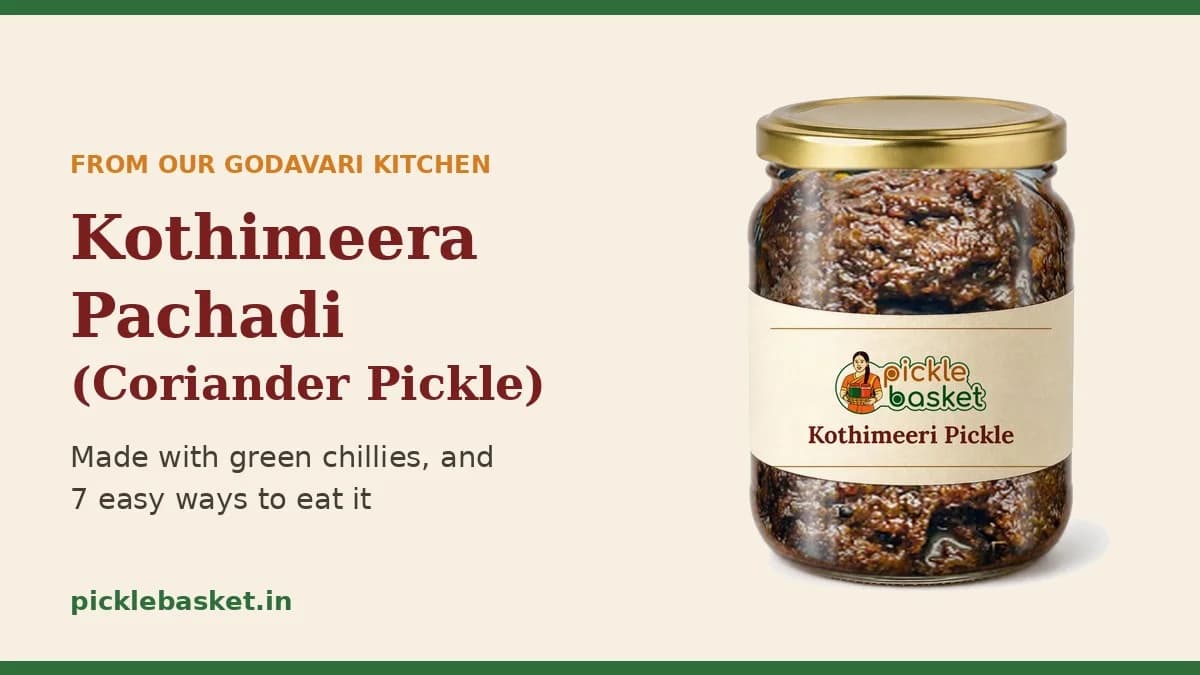
Kothimeera Pachadi: Andhra Coriander Pickle Made with Green Chillies, and 7 Ways to Eat It
In our house, the coriander seller came on a cycle. Two big baskets tied behind the seat, one full of kothimeera and one of pudina, and a call you could hear from three lanes away. When the bunches were cheap and fat, Amma bought far more than any curry needed, and we children knew why. By evening the whole kitchen would smell of coriander and garlic, and there would be a new jar on the shelf.
That jar is kothimeera pachadi, the Andhra coriander pickle. Some families say kothimeeri, some say kothimeera, and both mean the same leafy herb. We gave it a few lines in our post on everyday Andhra veg pickles. A jar this different deserves its own page, so here is the full story.
The Pickle That Uses Green Chillies, Not Red
On a typical Telugu pickle shelf, nearly everything is red: avakaya, tomato, lemon, pandu mirchi, gongura. Those pickles get their colour and their deep heat from red chillies, mostly as dried red chilli powder, and in pandu mirchi as fresh ripe red chillies ground into the pickle.
Kothimeera pachadi takes a different road. Its heat comes from fresh green chillies, so the spice feels quicker and brighter. It hits the tongue first and fades sooner, instead of building slowly like a red avakaya.
Do not expect the bright green of a fresh chutney, though. Once the leaves are cooked down with tamarind and jaggery, the pickle turns a deep, dark olive brown, and that is how a proper cooked pachadi should look.
That difference in heat is also why it pairs so well with the red-chilli jars. Put one spoon of each on a plate and they never fight each other.
What Goes Into Our Jar, and Why
Our Kothimeeri Pickle has a short list, and every item has a job.
- Fresh coriander leaves. The heart of the jar. Coriander is mostly water when fresh, so the bunches are washed and then dried completely before cooking. Even a few drops of water left behind can spoil a pickle.
- Green chillies. All of the heat, with none of the red chilli powder that the other jars use.
- Tamarind. Chintapandu gives the sour backbone. Without it, coriander alone tastes flat after a few days.
- A little jaggery. People are often surprised to see jaggery on the label. It is not there to make the pickle sweet. It rounds off the sharp edge of tamarind and chilli, the same way a small piece of bellam goes into a pot of pulusu.
- Garlic. For the savoury depth that Andhra tongues expect.
- The tempering. Mustard seeds, cumin, curry leaves from the curry tree and minapappu, the split black gram, crackled in groundnut oil. The black gram turns golden and gives tiny crunchy bites all through the jar. If you spot little pale pieces in your spoon, that is the minapappu.
- Salt and turmeric, as in every Telugu pachadi.
The leaves are cooked down with the chillies, garlic, tamarind and jaggery, ground, and then finished with the tempering. We cook it in small lots, and your jar is prepared once your order comes in.
Seven Ways to Eat Kothimeera Pachadi
We start with the old way. The rest come from our own family table. A teaspoon per serving is plenty, since the pickle is concentrated.
1. Mudda pappu, rice and one spoon of kothimeera
Plain mudda pappu (soft-cooked toor dal with salt) with hot rice and ghee is the comfort food of every Telugu home. It is mild by design, and it is waiting for a pickle. A spoon of kothimeera pachadi at the edge of the plate turns it into a meal you remember.
2. Idli and minapa dosa in the morning
On mornings when nobody has time to grind chutney, the jar does that job. Spread a thin layer on the hot dosa before folding, or keep a small spoon next to the idlis with a little extra oil poured over it.
3. Upma and pongal
Soft rava upma and ven pongal wake up with a sharp coriander pickle on the side. If you already love ginger pickle with pesarattu, as we wrote in our post on allam pachadi, this is the same idea with a fresher, herby taste.
4. Quick kothimeera rice for the lunch box
Mix one or two spoons of the pickle into warm rice, add a spoon of oil or ghee and a handful of roasted peanuts, and toss gently. In five minutes you have a coriander rice that travels well in a tiffin box. Taste before adding more, because the pickle already carries salt.
5. Inside chapati rolls and sandwiches
Spread a thin coat on a chapati, add leftover potato fry or scrambled egg, and roll it up. It also replaces mint chutney in a cucumber sandwich.
6. With curd rice at night
Cool perugu annam and a coriander pickle is a softer ending to the day than a fiery red one.
7. On the picnic mat
Because it goes with rice, chapati and dosa alike, it is one of the easiest jars to pack for an outing. Our post on Karthika Masam vanabhojanalu has more ideas for picnic pickles, and Karthika Masam is almost here.
Building a Balanced Order
Since it is the only jar on our shelf built on green chillies, it works best alongside one or two red-chilli pickles. A few combinations that work well:
- Herby and classic: Kothimeera with Avakaya, for one fresh and one deep, mustardy pickle.
- Herby and tangy: Kothimeera with Tomato Pickle, for families who like sour more than hot.
- The tiffin set: Kothimeera with Ginger Pickle, for homes where breakfast is idli, dosa or pesarattu most days.
You can see every jar on our vegetarian pickles page. If any Telugu names on the shelf are new to you, our glossary of Telugu pickle names explains them in plain English.
Pack Sizes and Prices
Three jar sizes are on the site right now:
- 250 g for ₹219 (MRP ₹399), enough to find out whether your family likes it
- 500 g for ₹429 (MRP ₹599), for homes with dosa or idli on most mornings
- 1 kg for ₹799 (MRP ₹1,099), for big joint families or for splitting with relatives
Prices do change now and then, so check the product page for today's figure before you order.
Looking After a Leaf Pickle
Moisture is what ruins a leaf pickle, so dip only a spoon that is fully dry, and never one that has touched dal or curd. Screw the lid on firmly after each use and store the jar somewhere cool, out of direct sun. Once opened, it keeps best in the fridge, and your jar's label gives the shelf life for that batch. More small habits are in our pickle storage guide.
Your Questions, Answered
Is kothimeera pachadi the same as gongura pachadi?
No. Both are leafy and both are sour, but gongura is made from sorrel leaves and red chilli, so it is dark red and much more sour. Kothimeera is made from coriander and green chilli, so it is herby, darker olive in colour and milder in sourness.
Does it taste sweet because of the jaggery?
Not really. The jaggery is a small amount that softens the tamarind and chilli. Most people do not notice it as sweetness at all.
Is Cash on Delivery possible?
It is, wherever the pincode is serviceable. Checkout asks for ₹99 online to lock in the order, the courier adds a ₹50 cash-collection fee, and the balance is paid when the parcel arrives, in cash or UPI. Prefer to skip that fee? Pay the whole amount online by UPI or card.
Bring Home a Jar of Kothimeera Pachadi
If you miss the smell of coriander cooking in Amma's kitchen, this is your jar. Add Kothimeeri Pickle to your cart on picklebasket.in. We prepare it after you order and hand it to the courier within 1 to 2 business days. Standard delivery then takes about 3 to 6 business days, depending on where you live. Or WhatsApp us on +91 9848658989 and we will take it from there. Cash on Delivery works too.
From our Godavari kitchen to yours,
Vidya
Founder, Pickle Basket
About the Author
Vidya
Founder, Pickle Basket