

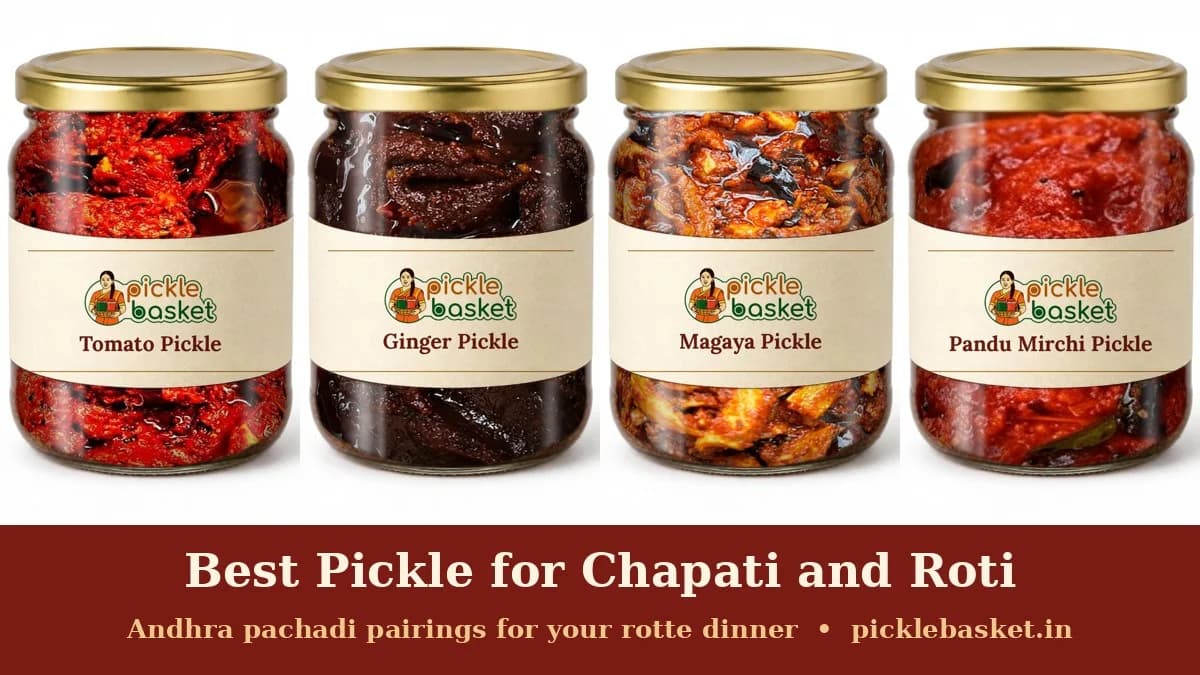
Best Pickle for Chapati and Roti: Andhra Pachadi Pairings for Your Rotte Dinner
When I was growing up in the Godavari side, dinner meant rice. Rice at lunch, rice at night, and if someone made rotte it was a special thing, usually on a fasting day. Today it is different. In many Telugu homes, including mine, the night meal is two or three chapatis with a curry. My husband started it for his own reasons, the children followed, and now the hot tawa is on almost every evening.
What surprised me was how quickly the pickle jar followed the chapati. Rice and pickle were always friends, but a soft, warm phulka with a spoon of the right pachadi folded inside is a meal on its own on a tired night. Many customers tell us the same thing on WhatsApp: "We eat roti now. Which of your pickles goes best with it?"
So here is our honest answer, from the kitchen, roti by roti.
Why Roti Needs a Different Pickle Than Rice
With rice, you mix. You break a piece of avakaya, rub the masala into the hot rice with ghee, and the rice carries the flavour into every grain. A chapati does not work like that. You tear a piece, scoop, fold and eat. The pickle sits on top of the bread instead of disappearing into it.
That changes what works best. With roti, three things matter:
- Texture. Smooth, ground pachadis and finely cut pickles spread and stay on the roti. Big hard pieces can roll off and are harder to scoop.
- Oil. A little oil is lovely on a dry phulka. Too much makes the roti soggy, so drain the spoon against the jar.
- Balance with the curry. Most roti meals already have a curry or dal. The pickle is the extra spark, so it should be strong in a small amount.
Keep these three in mind, and choosing becomes easy.
For Soft Phulka and Everyday Chapati: Tomato Pickle
If I had to pick only one jar for chapati, it would be our Tomato Pickle. It is made with ripe tomatoes, tamarind, red chilli, garlic, mustard and fenugreek in groundnut oil, cooked down to a thick paste.
That paste is the secret. It spreads on a warm chapati like a chutney, it does not slide off, and its sour-spicy taste suits almost every curry you might serve beside it, from aloo fry to a simple dal. Children who find mango pickles too sharp often like tomato pachadi rolled into a chapati. You can read more about this jar in our post on Andhra tomato pickle.
For Parathas and Stuffed Rotis: Magaya
A paratha is richer than a phulka. It is layered or stuffed, cooked with ghee or oil, and already full of flavour. Here a fierce pickle can fight with the stuffing. Magaya is the gentler mango choice: salted, sun-dried raw mango pieces pickled with red chilli, mustard, a little jaggery and tamarind.
The chewy mango pieces and the sweet-sour masala cut through the ghee of an aloo or methi paratha without overpowering it. Put one piece and a little masala on the side of the plate, with a bowl of curd, and you have a weekend breakfast that needs nothing else.
For a Quick Roll on Busy Nights: Ginger Pickle
Some evenings there is no time for curry. On those days I make chapatis, spread a thin layer of our Ginger Pickle on each one, add sliced onion and a few cucumber sticks, and roll them up. That is dinner.
Our allam pachadi is made with fresh ginger, tamarind, jaggery and red chilli in groundnut oil, so it is sweet, sour and warm at the same time. Because it is a ground pachadi, it spreads easily, and a small amount flavours the whole roll. Many people know it as the pickle for pesarattu, and we wrote about that pairing in our ginger pickle post. It is just as good with roti.
For Jonna Rotte and Thick Millet Rotis: Pandu Mirchi
In parts of Telangana and Rayalaseema, the roti on the plate is not wheat at all but jonna rotte, made from jowar, or sajja rotte from bajra. These thick, hand-patted rotis are close cousins of the bhakri of Maharashtra and Karnataka. They are earthy and slightly dry, and traditionally they are eaten with something fiery on the side.
Our Pandu Mirchi Pickle is made for that job. It is fresh ripe red chillies ground with mustard, fenugreek, garlic and salt in groundnut oil. It is hot, so start with the tip of a spoon, but against a plain jowar roti with a little curd or ghee, that heat feels exactly right. If you are not sure how much spice your family can handle, our spice-level guide will help.
For Non-Veg Lovers: Boneless Chicken Pickle
If your family eats meat, our Chicken Boneless pickle is the easiest non-veg pickle to pair with roti. The pieces are small and have no bones, so you can tear a chapati, pick up one piece with a little masala, and eat it without fuss. It is cooked in an Andhra masala of red chilli, garlic, ginger, coriander and warm spices in groundnut oil.
Two or three pieces folded into a chapati with onion and lemon is a filling meal. For more ideas with chicken pickle, see our post on ways to use kodi pachadi.
A Quick Pairing Guide
- Plain phulka with dal or sabzi: tomato pickle, or lemon pickle if you like it sharp.
- Aloo, gobi or methi paratha: magaya, with a bowl of curd.
- Chapati roll with no curry: ginger pickle or tomato pickle as the spread.
- Jonna rotte or sajja rotte: pandu mirchi pickle, in a small amount.
- Lunch box chapatis: a pickle with little loose oil, packed in a small separate box.
- Non-veg night: boneless chicken pickle folded into hot chapati.
Small Habits That Make It Better
- Serve the roti hot. A warm chapati softens the masala and lets the aroma come out. A cold roti makes even a good pickle taste flat.
- Drain the spoon. Press the spoon against the inside of the jar so extra oil stays in. Your roti stays soft, not soggy.
- Use less salt in the curry. Pickles are salty, so if you know the pickle is coming, go a little lighter on salt elsewhere.
- Keep a separate small bowl at the table. Spoon out what you need for the meal instead of passing the big jar around. It keeps the jar clean for the next day.
- Always use a dry spoon. Water is the enemy of pickle. Our guide on storing homemade pickles explains a few more kitchen habits.
A Starter Order for Roti Homes
If chapati is now your daily dinner, start with three 250 g jars: Tomato Pickle for everyday phulkas, Ginger Pickle for quick rolls, and Magaya for parathas. Our veg pickles are ₹219 for 250 g, ₹429 for 500 g and ₹799 for 1 kg. The Chicken Boneless pickle is ₹499 for 250 g, ₹849 for 500 g and ₹1,499 for 1 kg.
Every jar is made fresh after you order. You can browse all of them on our vegetarian pickles and non-veg pickles pages.
Order on Our Site or on WhatsApp
Order on picklebasket.in, or message us on WhatsApp at +91 9848658989 and tell us what kind of roti your family eats. We will help you pick the jars.
Cash on Delivery is available on all serviceable pincodes. You pay a ₹99 advance online to confirm the order, and a ₹50 COD fee applies. Paying fully online by UPI skips that fee. Orders are usually dispatched within 1 to 2 business days, and the latest terms are on our shipping policy page.
From our Godavari kitchen to your evening tawa,
Vidya
Founder, Pickle Basket
About the Author
Vidya
Founder, Pickle Basket