

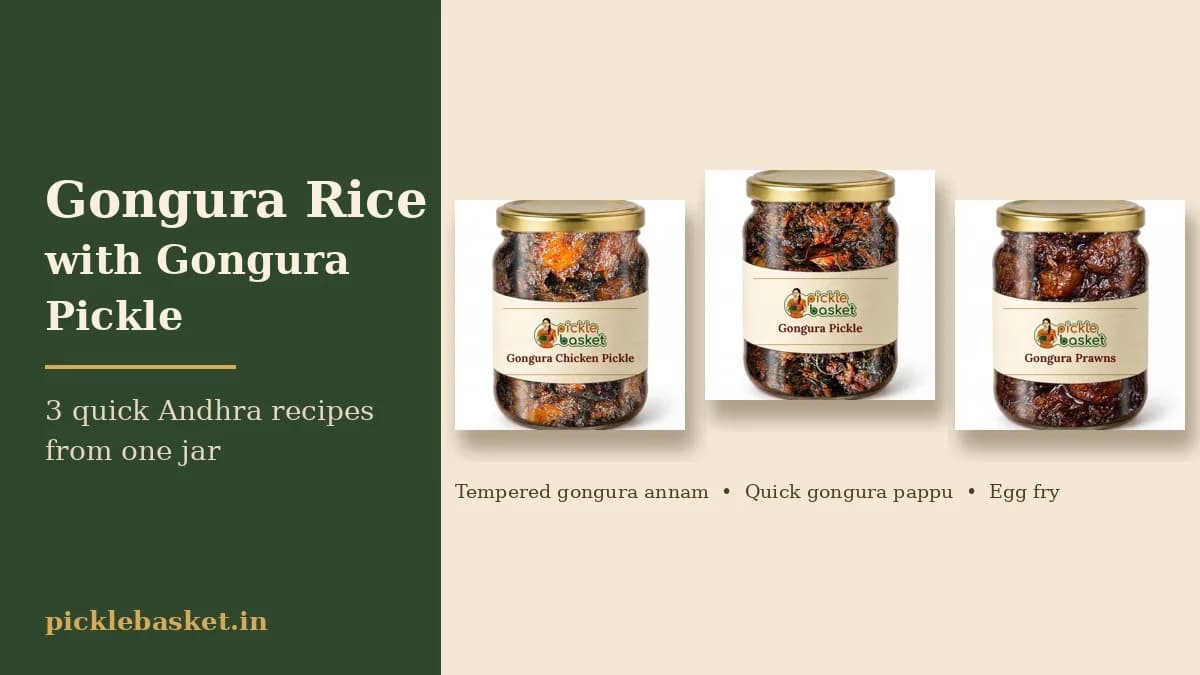
Gongura Rice With Gongura Pickle: Three Quick Andhra Recipes From One Jar
In Unguturu, fresh gongura comes home in thick bunches tied with a strip of banana fibre. My mother would pluck the leaves on the verandah, wash them, dry them on an old cotton saree, and only then start the cooking. It was half a morning's work for one pot of gongura pachadi.
Most of our customers do not have that morning, or a fresh bunch anywhere nearby. What they have is a jar. In many Telugu kitchens a jar of gongura pickle is quietly used as a cooking base, because the leaves are already cooked down with chilli, mustard and fenugreek. The hard part is done.
Here are three simple dishes from one jar of Gongura Pickle: tempered gongura rice for the lunch box, a shortcut gongura pappu, and a tangy egg fry.
Before You Start: Three Rules for Cooking With Pickle
- The pickle already has salt. Do not add salt until you have tasted the dish after the pickle goes in. Most times you will need very little, or none.
- Add the pickle at the end, on low heat. Gongura pickle is already cooked. Long frying only darkens the spices and makes the sourness bitter. Stir it in for the last minute.
- Use a dry spoon, and close the jar right away. Steam from the pan should never reach the open jar. Take out what you need into a small bowl first.
If you are new to gongura itself, our first-timer's guide to gongura pickle explains the taste. Gongura is the Telugu name for the leaves of the roselle plant, and their sourness is what every recipe here is built on.
Recipe 1: Tempered Gongura Rice (Gongura Annam) for the Lunch Box
Unlike the hand-mixed rice in our avakaya annam recipe, this is cooked in a pan with a popu (tempering), much like a pulihora, so it suits a lunch box.
What you need (serves 2)
- 2 cups cooked rice, spread on a plate and cooled (leftover rice from last night is perfect)
- 1½ to 2 tablespoons Gongura Pickle, with a little of its oil
- 2 tablespoons oil (groundnut oil suits the flavour)
- 2 tablespoons raw peanuts
- 1 teaspoon chana dal and 1 teaspoon urad dal
- ½ teaspoon mustard seeds
- 2 dry red chillies, broken
- A sprig of curry leaves
- A pinch of hing (inguva)
- 1 small onion, thinly sliced (optional)
How to make it
- Heat the oil in a wide bandi or kadai. Fry the peanuts on medium heat until they crackle and turn golden. Lift them out with a slotted spoon.
- In the same oil, add mustard seeds. When they splutter, add chana dal and urad dal and fry until light brown.
- Add the red chillies, curry leaves and hing. This is the tadka, and the smell should fill the kitchen.
- If using onion, add it now and fry until soft and just turning golden.
- Lower the heat. Add the gongura pickle and stir for 30 to 40 seconds, only until it is warm and loosened into the oil.
- Add the cooled rice. Toss gently with a flat ladle so the grains do not break, until every grain is an even dark green-brown.
- Switch off the heat, taste, and only then add a pinch of salt if needed. Scatter the fried peanuts on top.
Kitchen note: Too sharp? Add ghee or a little plain rice. Cooled rice matters, because freshly cooked rice turns mushy when tossed.
For packing it in a steel box with a side of curd, our office lunch dabba guide has the packing habits that keep the box tidy.
Recipe 2: Shortcut Gongura Pappu in 15 Minutes
Proper gongura pappu cooks fresh leaves with toor dal. Without leaves, a spoon of pickle stirred into a simple dal gets you close enough on a weeknight.
What you need (serves 3 to 4)
- ¾ cup toor dal (kandi pappu), pressure-cooked soft with a pinch of turmeric
- 1 to 1½ tablespoons Gongura Pickle
- 1 tablespoon oil or ghee
- ½ teaspoon mustard seeds and ½ teaspoon cumin
- 2 green chillies, slit
- 4 to 5 curry leaves
- A pinch of hing
How to make it
- Mash the cooked dal well and loosen it with hot water until it is like thick soup.
- Heat oil or ghee in a small pan. Add mustard and cumin, then green chillies, curry leaves and hing.
- Pour this popu into the dal and bring it to a gentle boil for two minutes.
- Switch off the heat. Stir in the gongura pickle a little at a time, tasting as you go. Stop when the dal turns pleasantly tangy.
- Check salt last.
Serve it with hot rice, ghee and a crisp appadam.
Recipe 3: Gongura Egg Fry (Gongura Guddu Vepudu)
For the evening when the fridge has only eggs.
What you need (serves 2)
- 4 eggs, hard-boiled, peeled and halved
- 1 tablespoon Gongura Pickle
- 1 medium onion, finely chopped
- 1 tablespoon oil
- A pinch of turmeric
- Chopped coriander to finish
How to make it
- Make a few light slits on the boiled egg halves so the masala can cling.
- Heat oil, add the onion and fry until golden.
- Add turmeric, then lower the heat and add the gongura pickle. Stir for half a minute.
- Place the eggs in, yolk side up first, and gently spoon the masala over them. Turn once.
- Finish with coriander. Taste before adding any salt.
Eat it with rice and rasam, or roll it into a chapati with a few onion rings.
Going Non-Veg: When the Pickle Already Has the Meat
The same tempered rice method works with our non-veg gongura jars, where the pickle brings both the sourness and the meat.
- Gongura Chicken Pickle makes a quick gongura chicken rice. Use 2 tablespoons for 2 cups of rice and skip the peanuts.
- Gongura Prawns suits a coastal-style rice with a few onion slices fried crisp on top.
- Gongura Mutton Pickle is rich, so use less and serve it with plain rice and curd on the side.
With the non-veg jars, add the pickle only for the last minute so the meat pieces stay tender. Take out just what you need with a dry spoon, and store the jar as its product page advises.
A Few Gentle Tips From Our Kitchen
- Use the oil on top. The flavoured oil in the jar is part of the taste. Our post on why Andhra pickles use so much oil has more ideas for it.
- Keep the jar happy. Push the remaining pickle back under its oil, close the lid tight and keep it away from the stove. Our storage guide covers the everyday care.
- Garlic note. Our Gongura Pickle lists garlic among its ingredients, so these dishes are not suitable for homes that avoid garlic.
Frequently Asked Questions
Can I make gongura rice without fresh gongura leaves?
Yes. A good gongura pickle already has the leaves cooked down with spices, so tempered rice with a spoon or two of pickle gives you a familiar gongura annam without plucking and cooking fresh leaves.
How much gongura pickle should I use for gongura rice?
Start with about 1½ tablespoons for 2 cups of cooked rice, taste, and add more if you want it sharper. Check the salt only after the pickle is mixed in.
Order Gongura for Your Kitchen
Keep a jar of Gongura Pickle on the shelf and weeknight cooking gets a lot easier. For non-veg homes, add Gongura Chicken or Gongura Prawns. Every jar is made fresh in small batches after you order, in our kitchen near Tadepalligudem. Please check each product page for the latest price and pack size.
Order on picklebasket.in or message us on WhatsApp at +91 9848658989. Cash on Delivery is available for serviceable pincodes, with a ₹99 advance paid online to confirm the order and a ₹50 COD fee; pay fully by UPI to skip the fee. Our shipping policy has the delivery timelines.
May your next plate of gongura annam smell like a Godavari kitchen, even if the leaves never made the journey.
With warmth,
Vidya
Founder, Pickle Basket
About the Author
Vidya
Founder, Pickle Basket