

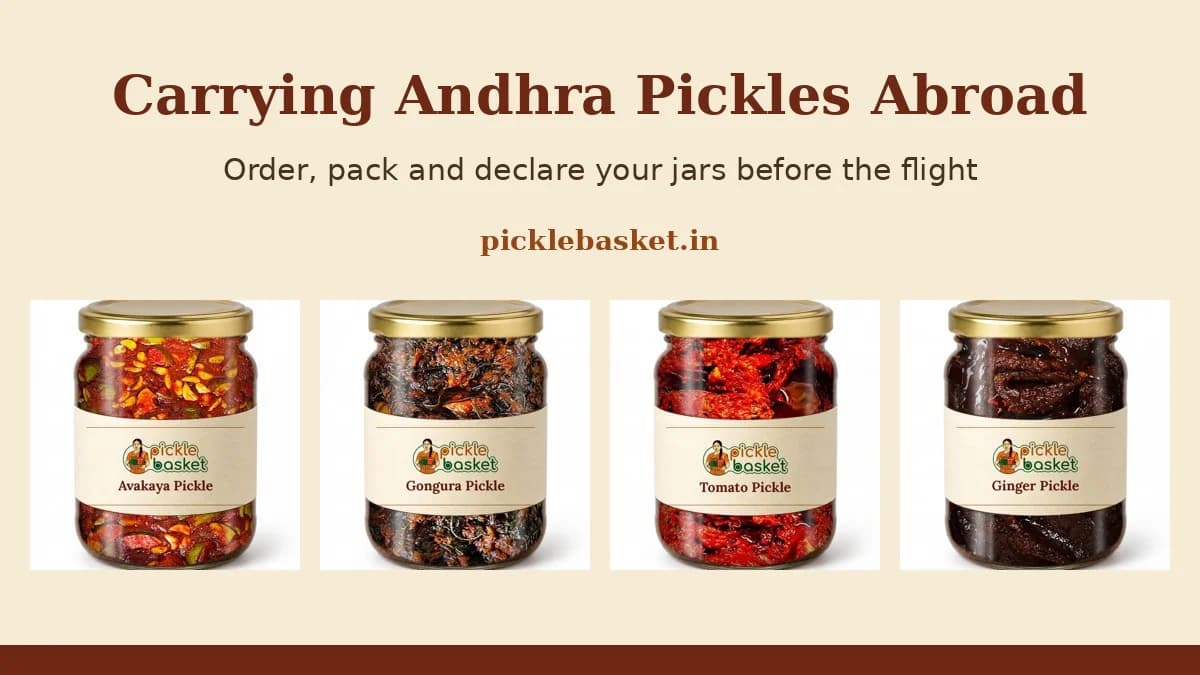
Carrying Andhra Pickles Abroad: How to Pack Pickle Jars for Your Flight to the US, UK or Gulf
Every Telugu family knows this scene. The flight to Dallas or London or Dubai is in four days, the suitcases are open on the floor, and Amma is standing over them with a list. Rava, podi, a few packets of snacks, and right on top of the list, underlined twice: avakaya. Nobody leaves for videsham without a jar of pachadi.
And then the questions start. Will the jar leak? Can it go in the cabin bag? Will customs throw it away? Should we take the chicken pickle or not?
This guide is for that week before the flight. It covers when to order, which pickles travel best, how to pack them so your clothes don't smell of mustard oil for a month, and what to check about the rules of the country you are flying to. One thing to know first: Pickle Basket delivers only within India, so the idea is simple. You order to your Indian address, and the jars travel with you.
Order Early, Because Every Jar Is Made After You Order
Our pickles are not sitting on a warehouse shelf. Every jar is prepared in small batches in our kitchen near Tadepalligudem after the order comes in. Our shipping policy says orders are packed and handed to the courier within 1 to 2 business days, and standard delivery usually takes 3 to 6 business days after dispatch, depending on your pincode.
So add it up before you book. For a flight at the end of the month, ordering about two weeks ahead is comfortable. It leaves room for a courier delay, a holiday or a weekend, and it gives you a day or two to repack the jars calmly instead of at midnight before the airport taxi arrives.
If you are not sure your parcel will reach in time, message us on WhatsApp with your flight date and pincode, and we will tell you honestly whether it is realistic.
Which Pickles Travel Best
When you are carrying pickles across borders, the simple rule is this: veg pickles are the safer choice. Most countries are much stricter about meat, fish and other animal products coming in with travellers than about a jar of mango or tomato pachadi. That doesn't mean every veg pickle is allowed everywhere, but it means fewer worries at the airport.
Here are the jars families most often pack for a long stay away:
- Avakaya Pickle is the one nobody forgets. Raw mango pieces, mustard, chilli and oil. If you can take only one jar, take this one, because it goes with rice, curd rice, dosa and even plain bread on a tired evening.
- Gongura Pickle is the taste Telugu people abroad miss the most, because sorrel leaves are hard to find in many cities outside India.
- Tomato Pickle is the gentle one. Children, spouses who didn't grow up with Andhra food and roommates from other states usually start here.
- Ginger Pickle is the quiet hero for people who cook breakfast abroad. A spoon of allam pachadi turns a plain pesarattu or upma into home.
Our non-veg pickles, like chicken, prawn and mutton, are made with meat or seafood. Rules for carrying meat and fish products into other countries are often strict, and some countries do not allow them in passenger baggage at all. Please check the official rules for your destination carefully before packing any of these, and if in doubt, enjoy them at home in India instead.
Cabin Bag or Checked Bag?
Pickle is mostly oil, chilli paste and juicy pieces, and airport security usually treats foods like that the same way as liquids and pastes. For example, the US Transportation Security Administration's liquids rule limits carry-on liquids, gels and pastes to containers of 100 ml or less and asks travellers to pack anything bigger in checked baggage. Airports in other countries have their own versions of this rule.
So a 250 g or 500 g jar of pickle belongs in your checked bag, not your cabin bag. Packing it in the cabin bag is the easiest way to lose it at security before you even board.
How to Pack Pickle Jars So Nothing Leaks
This is the part Amma is best at, and her method is still the right one. Baggage gets thrown, pressed and turned upside down, and the cabin pressure changes during the flight, so plan for the worst.
- Keep the jar sealed. Don't open it to taste before the trip. An untouched, tightly closed jar is far less likely to leak.
- Wrap the lid. Stretch a layer of cling film over the lid, then put a strip of tape around the edge where the lid meets the jar.
- Double-bag it. Put each jar into a zip-lock bag, squeeze the air out and seal it. Then put that bag inside a second one. If oil escapes, it stays inside the plastic.
- Cushion it. Wrap the bagged jar in a thick towel or a sweater and place it in the middle of the suitcase, surrounded by soft clothes, never against the outer wall or near the wheels.
- Stand it upright if your suitcase allows it, and keep it away from anything white or silk.
- Mind the weight. A few 500 g jars add up quickly. Weigh the bag at home so you don't have to open it at the check-in counter and take things out.
Keep a small card inside the bag listing what each jar contains in plain English, such as "mango pickle in oil" or "tomato pickle in oil". It makes the next step much easier.
Declare It at Customs
This is the step people skip, and it is the one that matters most. Many countries ask travellers to declare all food they are carrying. The US Customs and Border Protection page on bringing agricultural items into the US says all agriculture items must be declared and may be inspected, and that undeclared prohibited items can be confiscated and lead to a penalty. The UK government has a similar guide on bringing food into Great Britain, with separate rules for meat, dairy and fish products.
Rules change, and they are different for every country, so please read the official page for your destination close to your travel date. Our simple advice: tick "yes" for food on the arrival form, say clearly that you have pickles, and let the officer decide. Declaring an allowed jar costs you a few minutes. Hiding one can cost you much more.
When You Land: Making the Jar Last
Once you are settled, open one jar at a time and keep the others sealed in a cool, dark cupboard. Always use a dry spoon, and keep the open jar closed tightly between meals. Our guide on how to store homemade pickles has the full routine, and if anything ever looks or smells wrong, read how to tell if a pickle has gone bad before eating it.
Many students ration their avakaya carefully, one spoon on Sunday with pappu, and that one spoon is often what makes a new country feel a little less far away.
Not Flying? Send It Within India Instead
If your child has moved to another Indian city instead of abroad, you don't need to pack anything. We deliver across India, and our guide to sending homemade pickles to your children in another city explains how families do it. Travelling by train or road instead? Our post on packing pickles for train journeys and road trips has tips for that too.
Ordering Before Your Trip
At the time of writing, our veg pickles cost ₹219 for 250 g, ₹429 for 500 g and ₹799 for 1 kg, but please check the product page for current prices before you order. You can see every jar on our vegetarian pickles page.
Order on picklebasket.in or message us on WhatsApp at +91 9848658989. Tell us your travel date and we'll help you choose jars that suit the trip.
Cash on Delivery is available on all serviceable pincodes in India. You pay a ₹99 advance online to confirm the order, and our delivery partner adds a ₹50 COD fee. If you pay fully online by UPI, there is no COD fee. Our COD guide explains each step, and the latest terms are always on our shipping policy page.
Pack it well, declare it honestly, and take a little bit of Godavari with you wherever you go.
With love from our kitchen to your suitcase,
Vidya
Founder, Pickle Basket
About the Author
Vidya
Founder, Pickle Basket