

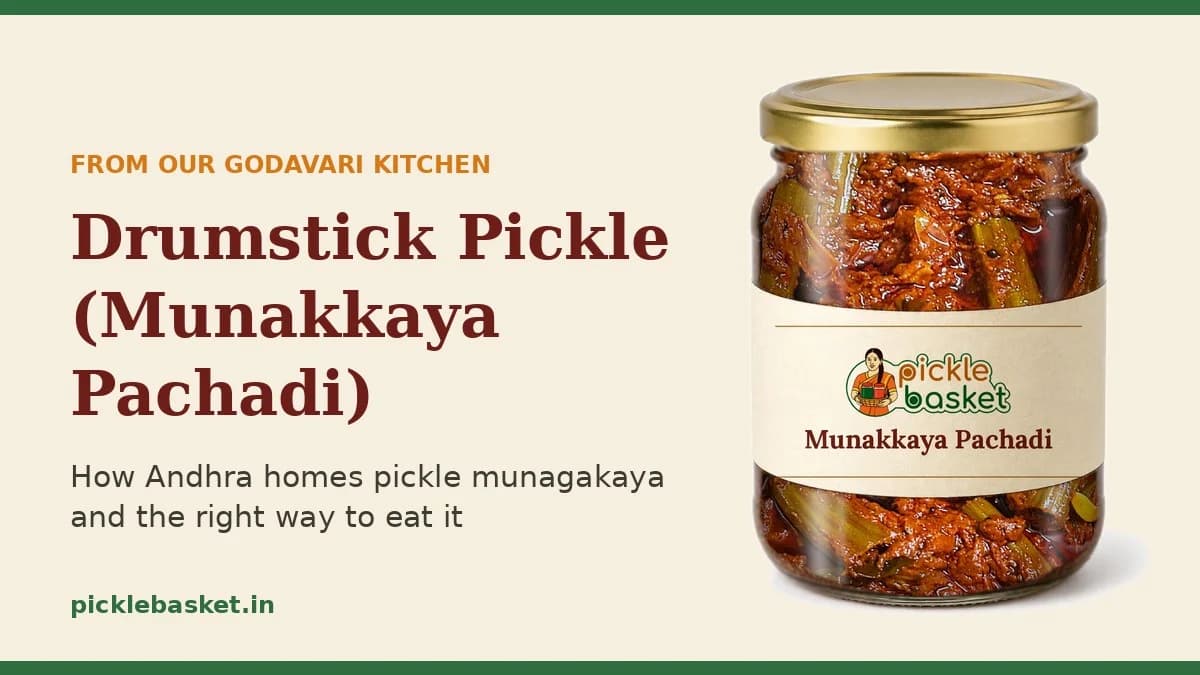
Drumstick Pickle (Munakkaya Pachadi): How Andhra Homes Pickle Munagakaya and How to Eat It
Ask anyone who grew up in a Godavari village about drumsticks and they will point to a tree, not a shop. The munaga chettu stood near the well or behind the cowshed in so many homes, and when it was heavy with long green pods, the whole lane ate drumsticks for weeks. Some went into Friday's sambar, some into a sour pulusu, and the best, firmest pods were set aside for one special jar.
That jar is munakkaya pachadi, the Andhra drumstick pickle. It is one of the few pickles where you do not just spoon the masala, you pick up a piece, hold it with your fingers and chew. We wrote a short note about it in our post on everyday Andhra veg pickles. So many of you have asked about it since then that it deserves a full post of its own.
Munakkaya, Munagakaya, Drumstick: One Vegetable, Many Names
In Telugu the pod is called munagakaya or munakkaya, depending on which district your grandmother came from. In English it is the drumstick, and botanists call the tree Moringa oleifera. Tamil homes say murungakkai, and in Hindi it is often sahjan.
So "drumstick pickle", "munagakaya pachadi" and "moringa pickle" all point to the same jar. Our glossary of Telugu pickle names lists more of these name pairs if you are new to Telugu food words.
Why You Rarely See It in Shops
Drumstick pickle is a home pickle, and there are honest reasons it has stayed that way.
- It takes patience. Each pod has to be washed, cut into finger-length pieces, lightly cooked and then dried properly before any masala touches it. A mango can be chopped and pickled in an afternoon. Drumsticks need more care.
- Not every pod works. Pods that are too tender go soft and mushy in the jar. Pods that are too old turn woody. Amma always pressed a pod with her thumb before deciding whether it was for pickle or for pulusu.
That is exactly why it has become a quiet favourite with Telugu families living far from home. Most people living in Bengaluru or Pune do not have a munaga tree in the backyard.
How We Make Munakkaya Pachadi
Our Munakkaya Pachadi follows the old way, and the ingredient list is short: drumsticks, red chilli powder, salt, turmeric and mustard seeds (avalu). There is no garlic, onion, sugar or jaggery in it.
- Choosing and cutting. Fresh, firm drumsticks are washed and cut into short pieces, so each one fits comfortably between your fingers.
- A light cook. The pieces are cooked just enough to soften the inside. They are not boiled to a mush.
- Drying. This is the step that cannot be rushed. Any water left on the pieces would spoil the pickle, so they are dried completely.
- The masala. Red chilli powder, freshly ground mustard, turmeric and salt are mixed together. Ground mustard is what gives Andhra pickles their sharp, nose-tingling bite. It comes from the brown mustard plant.
- Coating and packing. The dry pieces are tossed in the masala and packed into the jar.
Like every Pickle Basket jar, it is made in a small batch only after your order reaches us. It is not sitting in a warehouse waiting for you.
What Does Drumstick Pickle Taste Like?
Think of the masala first: red-chilli hot and mustardy, close to the avakaya family of flavours. Then comes the drumstick. The soft centre has a gentle, slightly sweet, earthy taste that soaks up the masala over time.
It is not sour like lemon or gongura pickle, and it is not sweet like magaya. It sits somewhere in between: savoury, spicy and very "village kitchen".
How to Eat Drumstick Pickle the Right Way
First-timers often ask us this, and it is a fair question. Here is how Telugu homes do it.
Chew, scrape, leave the skin
Pick up a piece with your fingers. Bite down lightly and pull it through your teeth, the same way you would eat a drumstick from sambar. The soft inside and the masala come away, and the tough green outer skin stays in your hand. Put the skin on the side of your plate. Nobody swallows it, and nobody expects you to.
One piece per plate is enough
A single piece plus a little masala from the jar is enough for a full plate of rice. Mix the masala into the rice first, then enjoy the piece in between mouthfuls.
Best Pairings for Munakkaya Pachadi
- Hot rice and ghee. The simplest and still the best. Mix a spoon of the masala into steaming rice with a little ghee, and keep a drumstick piece on the side.
- Pappu annam. Plain kandi pappu or tomato pappu with rice becomes a full Sunday lunch with one piece of munakkaya next to it.
- Sambar rice. It may sound like drumstick twice, but it works. The pickle adds a mustardy heat that the sambar does not have.
- Perugu annam. Cool curd rice and a spicy drumstick piece is a classic end to an Andhra meal.
If you enjoy mixing pickle into rice, our step-by-step guide to avakaya annam works just as nicely with drumstick masala.
Who Will Love This Jar?
- Telugu families outside Andhra who miss the munaga tree and the pickle that came from it
- People who like avakaya but want something with a different texture
- Anyone who likes a pickle they can actually chew, not just spread
For a balanced order, pair it with something tangy like our Tomato Pickle, something fresh and green like Kothimeeri Pickle, and the classic Avakaya. You can browse every jar on our vegetarian pickles page.
Pack Sizes and Prices
Munakkaya Pachadi comes in three sizes. At the time of writing, the prices on our site are:
- 250 g at ₹219 (MRP ₹399), a good first jar to see if your family takes to it
- 500 g at ₹429 (MRP ₹599), for homes that eat rice twice a day
- 1 kg at ₹799 (MRP ₹1,099), for large families or to share with your parents' home
Prices can change, so the Munakkaya Pachadi page always shows the price you will pay.
Caring for Your Jar
Use a clean, completely dry spoon every time, and lift pieces out with the spoon rather than with fingers. Keep the pieces under the oil layer, close the lid tightly, and store the jar in a cool, dry place away from sunlight. We recommend refrigerating it after opening for the best freshness, and the label on your jar has the shelf-life details for your batch. Our guide on how to store homemade pickles has a few more simple habits.
Frequently Asked Questions
Do I eat the whole drumstick piece?
No. Chew the piece to get the soft centre and masala, then leave the fibrous outer skin on your plate, just like drumsticks in sambar.
Is munakkaya pachadi very spicy?
It has a proper red-chilli and mustard heat, similar to an avakaya-style pickle. It is not as fiery as pandu mirchi. If you like avakaya, you will be comfortable with it.
Does it have garlic or onion?
No. The ingredients are drumsticks, red chilli powder, salt, turmeric and mustard seeds.
Can I order it with Cash on Delivery?
Yes. COD is available for serviceable pincodes. You pay a ₹99 advance online to confirm the order, a ₹50 COD fee is added, and you pay the rest at your door in cash or by UPI. If you pay the full amount online by UPI or card, there is no COD fee.
Order Munakkaya Pachadi Today
If the smell of drumstick sambar takes you straight back to your Ammamma's kitchen, this is the jar for you. Order Munakkaya Pachadi here on picklebasket.in. Your jar is made fresh after you order and leaves our kitchen within 1 to 2 business days. Standard delivery usually takes 3 to 6 business days after dispatch, depending on your pincode. Prefer to chat? Send a WhatsApp to +91 9848658989 and our team will place the order for you. Cash on Delivery is available too.
From our Godavari kitchen to yours,
Vidya
Founder, Pickle Basket
About the Author
Vidya
Founder, Pickle Basket