

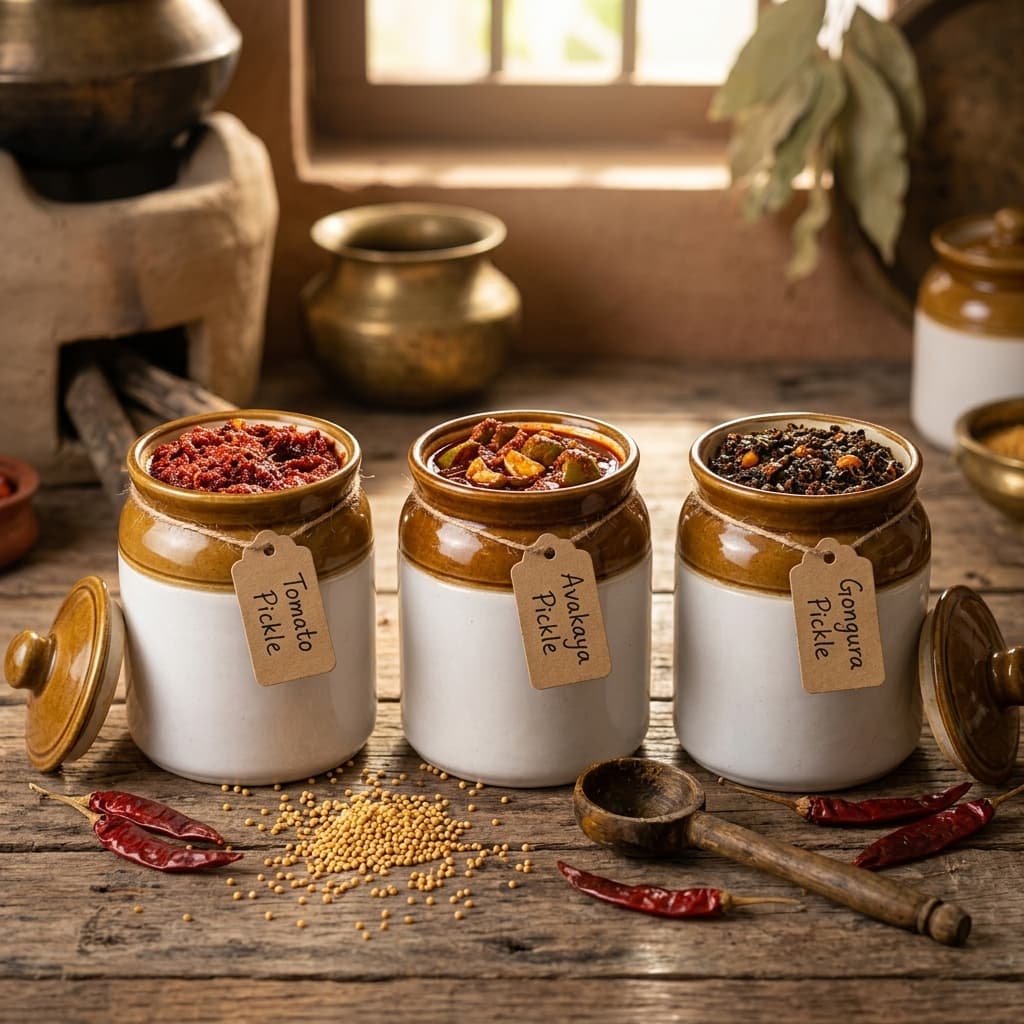
Homemade Pickles Online vs Store-Bought: What Really Changes in the Jar
Walk into any supermarket and you'll find an entire aisle of pickles. Mango, lemon, mixed vegetable, garlic. Neat labels, long shelf lives, prices that look reasonable. So why do so many people still search for "homemade pickles online"?
Because anyone who has eaten a pickle made in a home kitchen knows it tastes different. In this post, I'll try to explain honestly what changes between a small-batch homemade-style pickle and a mass-produced one. I'm obviously biased, since I make homemade pickles for a living, but I'll try to be fair. Mass-produced pickles have their place too.
1. How the Pickle Is Made
Mass-produced pickles are typically made in large batches in factories, using industrial equipment. The process is standardised so every jar tastes the same across thousands of units. This consistency is a real strength.
Homemade-style pickles are made in small batches, often by hand, following a family recipe. Each batch is mixed and tasted by someone who knows what it should taste like.
At Pickle Basket, every jar is prepared fresh in small batches after you order, in our kitchen in Tadepalligudem, West Godavari, using our family's Godavari recipes.
2. Ingredients
This is where you'll see the biggest difference, so always read the label.
- Mass-produced pickles may include ingredients that help with shelf stability, colour and consistency at large scale. Some use added acids, colours or chemical preservatives. Read the label to know what's in yours.
- Homemade-style pickles usually stick to the traditional list: the main ingredient, salt, oil, chilli, mustard, fenugreek, turmeric, and perhaps garlic, ginger or tamarind.
For example, our Avakaya Pickle lists raw mangoes, red chilli powder, mustard seeds, fenugreek seeds, turmeric, salt, asafoetida, groundnut oil, garlic and ginger. Our pickles use no artificial preservatives; they rely on traditional methods with salt, oil and spices.
3. Freshness
Store pickles may be made months before they reach the shelf, then sit in warehouses, trucks and shops. That's how the supply chain works.
Made-to-order pickles reach you much sooner after they're prepared. Our jars are handed to the courier within 1 to 2 business days of order confirmation, as per our shipping policy.
Fresher pickles often have brighter flavour: sharper mustard, fresher chilli, a livelier aroma.
4. Oil and Salt
Traditional homemade pickles are generous with oil and salt, because that's how they've always been preserved. Some commercial pickles may use less oil or rely on other methods for preservation.
There's no single "right" answer here, but it helps to understand that the oil layer in a homemade pickle is doing a job. We explain this in why Andhra pickles have a layer of oil.
5. Texture
Mass-produced mango pickle pieces are often uniform in size and texture. Homemade pickles vary a little more. Avakaya pieces cut by hand with the shell, grated koru pachadi with its soft texture, slow-cooked chicken pieces that stay tender. That variety is part of the charm.
6. Taste
This is personal. But most people describe homemade pickles as:
- More intense in flavour
- More balanced between sour, hot, salty and bitter
- More "like home", which is hard to define but easy to recognise
Mass-produced pickles tend to be milder and more uniform, designed to suit a wide national audience.
7. Variety
Supermarkets mostly stock popular pickles: mango, lemon, mixed vegetable. Regional specialities are rare. You won't usually find gongura mutton, munakkaya pachadi, koru pachadi or pandu mirchi on a supermarket shelf. Small-batch makers can offer traditional varieties that are hard to scale.
8. Price and Convenience
Let's be fair: store-bought pickles are usually cheaper and instantly available. You can pick one up with your groceries. Homemade-style pickles cost more because of small-batch preparation, hand work and individual shipping, and you have to wait for delivery.
Whether the difference is worth it depends on how much pickle means to you. For many Telugu families, it really does.
A Checklist for Buying Homemade Pickles Online
Not every pickle labelled "homemade" is the same. Before you buy, check:
- Is the ingredient list clear and familiar? Read it on the product page.
- Where is it made? A real address and kitchen location is a good sign.
- Is it made after you order, or pre-made?
- How is it packed? Look for airtight, leak-proof packing for oil-based pickles.
- Are delivery timelines and policies published? Read the shipping and refund pages.
- Is there a way to contact real people? A WhatsApp number or phone line helps.
- Can you pay on delivery? COD can give first-time buyers confidence.
- Is the website the real one? Some names sound similar. We once had to clarify that Pickle Basket is not Pickles Basket.
Frequently Asked Questions
Are homemade pickles healthier than store-bought?
We can't make health claims. Homemade-style pickles usually have a shorter, more familiar ingredient list. Always read labels and eat pickles in moderation.
Why are homemade pickles more expensive?
Small batches, hand preparation and individual packing and shipping all cost more than factory production.
Do homemade pickles last as long as store pickles?
It depends on the pickle and how you store it. Follow the shelf-life details on the jar label and keep the pickle under oil with a dry spoon.
Are Pickle Basket pickles really homemade?
Yes. They're made in small batches in Tadepalligudem, Andhra Pradesh, using traditional family recipes, and prepared after you place your order.
Try the Homemade Difference
Taste for yourself. Start with Avakaya and Tomato Pickle, browse all our homemade Andhra pickles online, or go straight to veg pickles, non-veg pickles, avakaya and mango pickles or chicken pickle. Cash on Delivery is available for serviceable pincodes.
With love from our kitchen,
Vidya
Founder, Pickle Basket
About the Author
Vidya
Founder, Pickle Basket